General Enquiries :
+91 80 6215 3300Emergency Number :
+91 80 6215 3400Pre-Book Your Appointments :
1800 123 1133
General Enquiries :
+91 80 6215 3300Emergency Number :
+91 80 6215 3400Pre-Book Your Appointments :
1800 123 1133



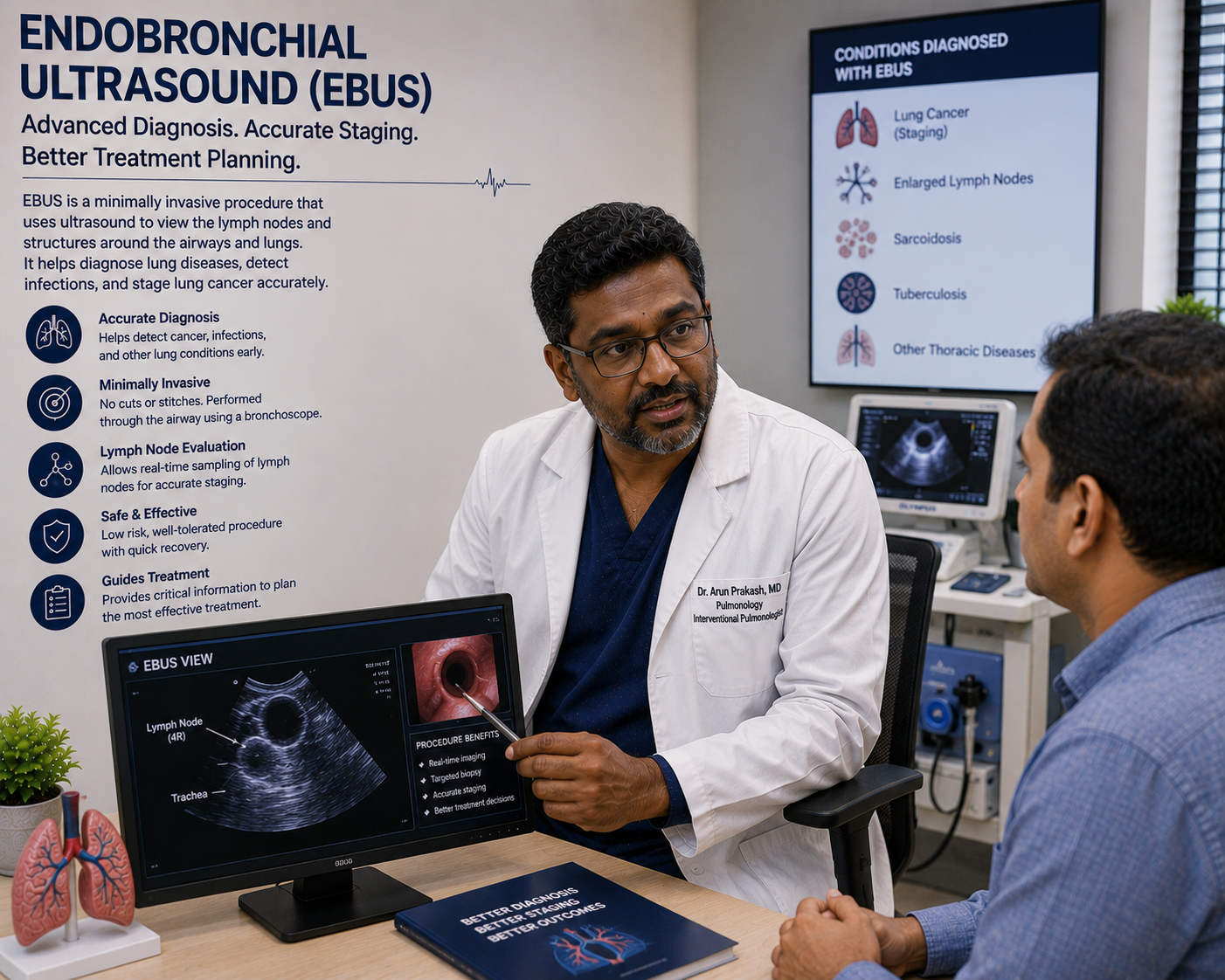
Endobronchial Ultrasound (EBUS) is a minimally invasive diagnostic procedure used to evaluate and sample structures within and adjacent to the airways of the lungs, including lymph nodes, masses, and tumours. EBUS combines bronchoscopy with real-time ultrasound imaging, allowing pulmonologists to visualise airway walls, mediastinal structures, and peribronchial tissues with high precision. It is particularly valuable in diagnosing lung cancer, sarcoidosis, tuberculosis, and other mediastinal or hilar lymphadenopathies.
During the procedure, a flexible bronchoscope equipped with an ultrasound probe is inserted through the patient’s nose or mouth into the trachea and bronchi. The ultrasound allows visualisation of lymph nodes and masses, while a fine needle can be passed through the airway wall to obtain tissue samples (EBUS-guided transbronchial needle aspiration, or TBNA) for cytology, histopathology, or molecular analysis. This approach reduces the need for more invasive surgical procedures like mediastinoscopy.
EBUS is performed under local anaesthesia with sedation or general anaesthesia, depending on patient requirements and procedural complexity. The procedure is safe, with minimal complications, and usually takes 30–60 minutes. Post-procedure monitoring ensures patient stability, with most patients able to resume normal activities the same day. The EBUS department works closely with pulmonology, oncology, pathology, and radiology services to provide a comprehensive diagnostic pathway. By offering accurate, real-time visualisation and targeted tissue sampling, EBUS facilitates early diagnosis, precise staging of lung cancer, and appropriate treatment planning. It has become an indispensable tool in modern pulmonary medicine, improving patient outcomes while minimising risk and recovery time.
Has touched more than a million lives


Emergency: +91 80 6215 3400
© Copyright 2026 Ramaiah Memorial Hospital